 Scanner Radio
/
Blog
Scanner Radio
/
Blog
Long before anyone was listening in, police departments were figuring out how to talk to their own officers over the air. In the late 1920s, the Detroit Police Department put one of the first practical two-way radio programs into service, letting a dispatcher reach patrol cars that had previously been unreachable once they left the station. Within a decade, municipal radio dispatch was spreading across the country. A car could be sent to an address in seconds instead of waiting for an officer to find a callbox and phone in.
That shift created something new: a stream of operational conversation traveling through the air over public airwaves. It was never secret. Anyone with a receiver tuned to the right frequency could hear it. The question, for a long time, was simply who had the equipment to bother.
The first receivers built specifically for monitoring public safety radio arrived in the 1960s and 1970s, and they worked in a way that sounds almost absurd today. Each channel you wanted to hear required a physical quartz crystal, cut to a specific frequency, plugged into the radio. Want to monitor your city's police dispatch, the fire department, and the county sheriff? That was three crystals, ordered by mail, one slot each.
Brands like Bearcat and Regency turned this into a consumer product, and the word "scanner" comes from what these radios did mechanically: they scanned through their installed crystals one at a time, stopping whenever a channel came alive with traffic. A four-channel or eight-channel scanner was a real commitment. If a department changed frequencies, your crystal became a paperweight, and you mailed off for a new one. Listening was a hobby that rewarded patience and a small budget for quartz.
The leap came when scanners went programmable. Instead of buying a crystal for every frequency, you could punch numbers into a keypad and store dozens, then hundreds, of channels in memory. Suddenly a listener could hold an entire region's worth of police, fire, EMS, public works, and even railroad and aviation frequencies in a single handheld unit and reprogram it in minutes.
This is the era that built the modern scanner community. Hobbyists traded frequency lists, published local channel guides, and compared notes on what agencies used which bands. Knowing the frequencies was half the craft, and learning the shorthand spoken on them was the other half. Much of the terminology from that period, the ten-codes and signal codes dispatchers rattle off, is still in use today, and it is worth understanding if you want to follow along. Our guide to police scanner codes breaks down the most common ones.
As radio traffic grew, agencies needed more efficient ways to share limited airwaves, and in the 1990s many moved to trunked systems. Instead of one channel per department, a trunked system pools a set of frequencies and assigns them on the fly, so a single conversation might hop across several frequencies in the span of a minute. Ordinary scanners could not follow that hopping, and for a while it looked like listeners had been locked out.
The hobby adapted. Trunk-tracking scanners arrived that could follow a system's control channel and stay locked onto a conversation as it moved. Then came digital voice, where transmissions are encoded rather than sent as plain analog audio, requiring scanners capable of decoding those formats. Each shift raised the cost and complexity of the hardware, and the community of people who could keep up got a little smaller and a little more technical.
The change that reopened scanner listening to everyone had nothing to do with buying better radios. It was the internet. Enthusiasts with capable receivers began connecting them to computers and streaming the audio online, so that a single well-equipped listener could relay a feed to anyone, anywhere, with a connection. You no longer needed the hardware, the frequency list, or line of sight to a transmitter. You needed a browser.
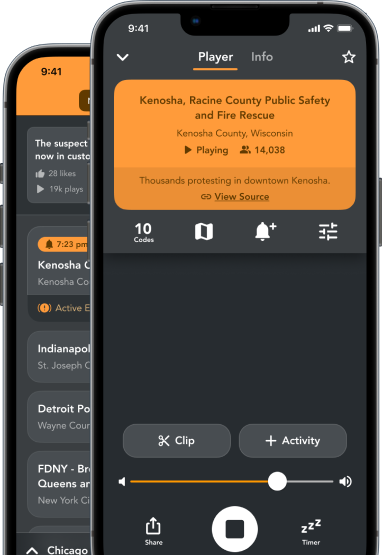
Smartphones finished the job. Scanner Radio grew out of this moment, gathering thousands of these listener-run feeds into one app so that opening a live police or fire channel became as simple as opening a song. Today more than 7,000 feeds across the United States and Canada are a tap away, which is a strange thing to sit next to the memory of mailing off for a single crystal.
The technology kept changing, but the reason people tune in never did: to hear what is happening, unfiltered, as it happens. What is different now is that the audience is a community rather than a scattering of hobbyists in separate basements. On Scanner Radio, listeners tag the incident type unfolding on a feed in real time, so a wildfire, a building fire, or a large police response surfaces as a headline other listeners can see at a glance. Sudden spikes in the number of people on a given feed get pushed out as alerts, and that surge is often the earliest sign that something big is underway.
If you are new to all of this and want the basics of how the receivers and feeds fit together, start with what a police scanner actually is. The learning curve is far shorter than it was for the crystal generation.


A century after Detroit first put a radio in a patrol car, the same conversations are still traveling over the air. The only thing that keeps changing is how easy it is to listen.