 Scanner Radio
/
Blog
Scanner Radio
/
Blog
Ten-codes were invented for a technical reason that no longer exists. In 1937, Illinois State Police communications director Charles Hopper was dealing with early radios built around vacuum tubes and dynamotors, which needed a moment to spin up to full power. The first syllable of any transmission got clipped. Prefixing everything with "ten" gave the transmitter time to reach full power before the meaningful part of the message arrived.
The Association of Public-Safety Communications Officials, APCO, developed those signals into a published list, expanded it through the 1960s, and issued the version most people mean when they say "the ten-codes" in APCO Project 14 in 1974.
The clipping problem was solved decades ago. The codes stuck around anyway, because by then they were faster to say than the phrases they replaced and everyone on the channel already knew them.
APCO's list was a recommendation, not a mandate. Agencies were free to adopt it, modify it, or ignore it, and over eighty years plenty did all three. It is genuinely rare to find two agencies whose code sets match exactly.
The clearest example is 10-13. On the APCO list, 10-13 asks for a weather and road conditions report. To the NYPD and a number of other large metropolitan departments, 10-13 means an officer needs emergency help right now.
Same two digits. One is a routine question about the roads, the other is the most urgent call on the channel. That gap is exactly why federal agencies started pushing departments toward plain language after 2005.
So treat the list below as the baseline, not the law. It will get you most of the way on most feeds, and where your local agency does something different, you will usually be able to tell from context within a few minutes of listening.
You don't need to buy a physical radio to hear any of this. The easiest way to start is to download Scanner Radio on your phone. It's free.
Live police, fire & EMS radio


This is the full APCO list, 10-0 through 10-99. Most agencies use only a fraction of it day to day, and the ones you will hear over and over on a typical feed are 10-4, 10-7, 10-8, 10-9 and 10-20. The rest are worth having when something unusual comes across the channel.
| Code | Meaning |
|---|---|
| 10-0 | Use caution |
| 10-1 | Signal weak, unable to copy, change location |
| 10-2 | Signal good |
| 10-3 | Stop transmitting |
| 10-4 | Acknowledged, message receivedOne of the handful of codes that means the same thing almost everywhere. |
| 10-5 | Relay this message |
| 10-6 | Busy, stand by unless urgent |
| 10-7 | Out of serviceWidely consistent. Some agencies add a suffix for the reason, such as out of service at a meal break. |
| 10-8 | In service, available for calls |
| 10-9 | Repeat your last message |
| 10-10 | Fight in progress |
| 10-11 | Dog case |
| 10-12 | Stand by |
| 10-13 | Weather and road conditions reportThe most notorious variation on the list. To the NYPD and a number of other big-city departments, 10-13 means an officer needs emergency help. |
| 10-14 | Prowler report |
| 10-15 | Civil disturbance |
| 10-16 | Domestic disturbance |
| 10-17 | Meet complainant |
| 10-18 | Complete assignment quickly |
| 10-19 | Return to station |
| 10-20 | LocationAlmost universal, and the one code most people already know from movies. |
| 10-21 | Call by telephone |
| 10-22 | Disregard |
| 10-23 | Arrived at scene |
| 10-24 | Assignment completed |
| 10-25 | Report in person, meet |
| 10-26 | Detaining subject, expedite |
| 10-27 | Driver's license check |
| 10-28 | Vehicle registration check |
| 10-29 | Check for wanted or stolen |
| 10-30 | Unnecessary use of radio |
| 10-31 | Crime in progress |
| 10-32 | Man with a gun |
| 10-33 | Emergency traffic, clear the channelSome agencies use 10-33 specifically for an officer needing help, closer to the NYPD sense of 10-13. |
| 10-34 | Riot |
| 10-35 | Major crime alert |
| 10-36 | Correct time |
| 10-37 | Investigate suspicious vehicle |
| 10-38 | Stopping suspicious vehicle |
| 10-39 | Urgent, use lights and siren |
| 10-40 | Silent run, no lights or siren |
| 10-41 | Beginning tour of duty |
| 10-42 | Ending tour of duty |
| 10-43 | Information |
| 10-44 | Permission to leave patrol |
| 10-45 | Animal carcass in roadway |
| 10-46 | Assist motorist |
| 10-47 | Emergency road repairs needed |
| 10-48 | Traffic signal repair |
| 10-49 | Traffic light out |
| 10-50 | Traffic accidentOften qualified as fatal, personal injury or property damage. California agencies use their own 11-80 and 11-81 instead. |
| 10-51 | Wrecker or tow truck needed |
| 10-52 | Ambulance needed |
| 10-53 | Road blocked |
| 10-54 | Livestock on highway |
| 10-55 | Suspected drunk driver |
| 10-56 | Intoxicated pedestrian |
| 10-57 | Hit and run |
| 10-58 | Direct traffic |
| 10-59 | Convoy or escort |
| 10-60 | Squad in vicinity |
| 10-61 | Isolate self for message |
| 10-62 | Reply to message |
| 10-63 | Prepare to make written copy |
| 10-64 | Message for local delivery |
| 10-65 | Net message assignment |
| 10-66 | Message cancellation |
| 10-67 | Clear for net message |
| 10-68 | Dispatch information |
| 10-69 | Message received |
| 10-70 | Fire |
| 10-71 | Advise nature of fire |
| 10-72 | Report progress on fire |
| 10-73 | Smoke report |
| 10-74 | Negative |
| 10-75 | In contact with |
| 10-76 | En route |
| 10-77 | Estimated time of arrival |
| 10-78 | Need assistance |
| 10-79 | Notify coroner |
| 10-80 | Chase in progress |
| 10-81 | Breathalyzer |
| 10-82 | Reserve lodging |
| 10-83 | School crossing detail |
| 10-84 | Advise your ETA |
| 10-85 | Delayed |
| 10-86 | Officer on duty |
| 10-87 | Pick up or distribute checks |
| 10-88 | Advise present telephone number |
| 10-89 | Bomb threat |
| 10-90 | Bank alarm |
| 10-91 | Pick up prisoner or subject |
| 10-92 | Improperly parked vehicle |
| 10-93 | Blockade |
| 10-94 | Drag racing |
| 10-95 | Prisoner or subject in custody |
| 10-96 | Mental subject |
| 10-97 | Radio test, check signal |
| 10-98 | Prison or jail break |
| 10-99 | Wanted or stolen indicated |
Response codes are separate from ten-codes and answer a different question. A ten-code says what is happening. A response code says how fast to get there.
| Code | Meaning |
|---|---|
| Code 1 | Routine. Respond when convenient, no urgency.Some agencies, including the LAPD, do not use Code 1 at all and treat Code 2 as their baseline. |
| Code 2 | Urgent. Respond promptly, but without lights or siren. |
| Code 3 | Emergency. Lights and siren, immediate response.This one has legal weight. Running Code 3 is what triggers the vehicle code exemptions letting an officer exceed the speed limit and proceed through red lights, so dispatchers assign it deliberately. |
| Code 4 | No further assistance needed. Scene is under control. |
| Code 5 | Stakeout in progress. Uniformed units stay away.Codes 5 and above are agency-specific. These meanings are the LAPD set, widely copied across California and beyond. |
| Code 6 | Out of the car, conducting an investigation. |
| Code 7 | Meal break. |
California never fully adopted the APCO list. It built its own, and because so much film and television is made in Los Angeles, its numbers leaked into the national vocabulary. Plenty of people know what a 187 is without ever having heard one on an actual radio.
Two things worth knowing: the 11-series covers traffic, and the bare three and four digit numbers are statute sections, not radio codes. They only mean anything in a state whose code book uses those numbers.
| Code | Meaning |
|---|---|
| 11-24 | Abandoned vehicle in the roadway |
| 11-25 | Traffic hazard, with the officer naming the type, such as debris, a downed sign or an animal |
| 11-44 | Fatality at the scene |
| 11-80 | Traffic collision with major injuries |
| 11-81 | Traffic collision with minor injuries |
| 11-85 | Tow truck requested |
| 187 | MurderCalifornia Penal Code section 187. Not a radio code, and not meaningful in most other states. |
| 211 | RobberyCalifornia Penal Code section 211. |
| 415 | Disturbing the peace, covering fighting in public, unreasonable noise and provocative languageCalifornia Penal Code section 415. |
| 459 | BurglaryCalifornia Penal Code section 459. |
| 5150 | Involuntary psychiatric hold of up to 72 hoursCommonly misattributed to the Penal Code. It is section 5150 of the California Welfare and Institutions Code, under the Lanterman-Petris-Short Act. |
Fire and EMS traffic sounds different from police traffic, and the difference trips up a lot of new listeners. Fire ground communication leans on plain-language terminology rather than numeric codes, partly because it has to work when three departments from three counties show up at the same building.
These are the terms that carry the most information on a fire feed.
| Term | Meaning |
|---|---|
| Size-up | The first-arriving officer's on-air description of what they have found. If you only listen to one transmission on a fire call, make it this one. |
| Working fire | A confirmed fire that will need a committed, full response, as opposed to an alarm that turns out to be nothing. |
| All hands | Every company assigned to the incident is committed and working. A status report on the response, not a request for more units. |
| Box alarm | A preassigned package of companies dispatched together to an address, each with a job decided before they roll. Named for the street corner pull boxes that used to trigger them. |
| Second alarm | A request for another full assignment on top of the first, roughly doubling the units on scene. Third, fourth and fifth alarms keep stacking from there. |
| Staging | Units holding at a nearby location, ready but not yet committed, so the scene does not get clogged. |
| PAR | Personnel Accountability Report. A radio roll call of every crew working the incident, to confirm everyone is accounted for. Called at intervals and after anything significant happens. |
| RIT or RIC | Rapid Intervention Team or Crew. A team standing by doing nothing else, whose only job is rescuing firefighters. |
| Mayday | A firefighter is trapped, injured or missing and needs immediate rescue. Reserved strictly for that, which is why it cuts through everything else on the channel. |
| Under control | The fire is no longer spreading. Some departments announce this as striking out the box. |
When an officer spells a plate or a name, they are usually not using the military alphabet. APCO formally switched to the international NATO alphabet in 1974, and most American police departments simply never went along with it. The 1940 Adam-Boy-Charles set is still what you will hear on the majority of US police feeds.
| Letter | Police (APCO 1940) | NATO |
|---|---|---|
| A | Adam | Alpha |
| B | Boy | Bravo |
| C | Charles | Charlie |
| D | David | Delta |
| E | Edward | Echo |
| F | Frank | Foxtrot |
| G | George | Golf |
| H | Henry | Hotel |
| I | Ida | India |
| J | John | Juliett |
| K | King | Kilo |
| L | Lincoln | Lima |
| M | Mary | Mike |
| N | Nora | November |
| O | Ocean | Oscar |
| P | Paul | Papa |
| Q | Queen | Quebec |
| R | Robert | Romeo |
| S | Sam | Sierra |
| T | Tom | Tango |
| U | Union | Uniform |
| V | Victor | Victor |
| W | William | Whiskey |
| X | X-ray | X-ray |
| Y | Young | Yankee |
| Z | Zebra | Zulu |
This is the question that brings most people to a page like this, and it deserves an honest answer: no list on the internet can tell you your local codes with certainty, because your local agency decided them and may not have written them down publicly.
What does work, in rough order of effort:
Opening a feed for your own city and following along for twenty minutes teaches you more than any list will. Pick the busiest feed your area has rather than the quietest, since a channel with steady traffic gives you far more repetitions to learn from.
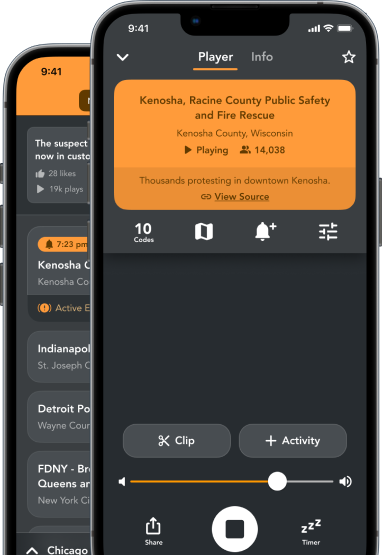
One more thing that helps while you are still learning a local set: on Scanner Radio, listeners tag the type of incident happening on a feed as it unfolds, and those tags surface as headlines alongside the audio. You can see at a glance what kind of event is in progress, which is useful context when a quiet channel suddenly gets busy.
The 10-13 problem stopped being theoretical in 2005. During the response to Hurricane Katrina, responders from different jurisdictions found they could not reliably understand each other's radio codes, and after-action reviews of the September 11 response had already flagged the same failure.
FEMA subsequently discouraged ten-codes precisely because their meanings varied so widely. The Department of Homeland Security's SAFECOM program has published guidance on moving to plain language, and ten-codes are not permitted at all in the national Incident Command System, the framework agencies use when multiple organizations work one incident. Nineteen states had switched to plain English by the end of 2009.
Most departments landed on a hybrid. Plain language for anything urgent or shared across agencies, and a handful of retained ten-codes for routine status, which is why 10-8 and 10-7 have outlived almost everything else on the list. If you want a sense of how the whole chain fits together, our piece on how emergency dispatch works covers what happens between the call and the radio traffic.
For listeners this is straightforwardly good news. A feed that says "structure fire, heavy smoke showing, second alarm" is far easier to follow than one that says 10-70 and expects you to know whose 10-70 it is.
10-4 means the message was received and understood. It is the single most widely recognized radio code in the United States and one of the very few that means the same thing in almost every agency.
10-7 means out of service, so the unit is unavailable for calls. 10-8 is the opposite: in service and available. You will hear both constantly at the start and end of a shift, and they are among the most consistent codes across agencies.
No. APCO published a recommended list, but agencies were free to modify it and many did. The clearest example is 10-13: on the APCO list it means a weather and road conditions report, but to the NYPD and a number of other big-city departments it means an officer needs emergency help. It is rare to find two agencies with identical code sets.
There is no national list that will answer this, because codes are set agency by agency. The reliable approach is to start from the APCO list above, listen to your local feed, and note where what you hear does not match. Many agencies publish their radio procedures, and county 911 centers often list their codes in public documents.
Code 3 is an emergency response with lights and siren. It matters legally as well as practically, because running Code 3 is what allows an officer to exceed the speed limit and proceed through red lights under the vehicle code, so dispatchers do not assign it casually.
Only partly. Fire and EMS lean much more heavily on plain-language terminology than on numeric codes. Instead of a code number you will hear phrases like working fire, all hands, staging, PAR and under control, which describe what is happening rather than encoding it.
After Hurricane Katrina in 2005, FEMA discouraged 10-codes because agencies arriving from different jurisdictions could not understand each other. The Department of Homeland Security pushed agencies toward plain language, and 10-codes are not permitted in the national Incident Command System. Nineteen states had switched to plain English by the end of 2009.